Before the Phrasebook, Travelers Carried Words Across Languages
Travel language aids show how words crossed borders before phrasebooks: learn how lists, glossaries, and guides reshaped contact between travelers and hosts.
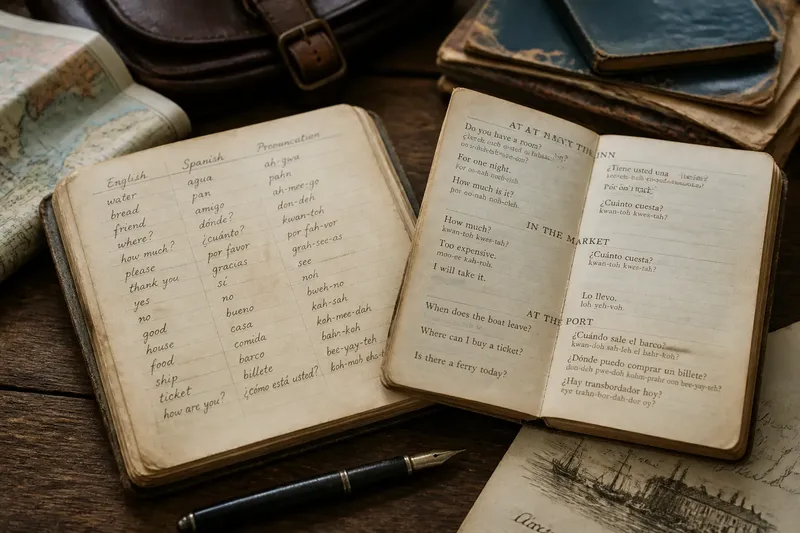
Travel language aids carried more than vocabulary: they carried a traveler’s assumptions about which words mattered and how an encounter should unfold. Before the phrasebook became a familiar travel format, lists and glossaries moved words between languages by selecting, arranging, and sometimes simplifying them.
Travel language lists made exchange selective
A handwritten vocabulary list could travel where a dictionary was too bulky or a local speaker was unavailable. Its compiler chose what to preserve: place names, food terms, greetings, requests, or words heard along a route. That selection made the list useful, but it also gave a narrow view of the language it represented.
Lists often placed words side by side as if each had a stable match in another language. In practice, a traveler might use a written equivalent to point, prompt a conversation, or recognize a term, while the other speaker supplied context the page could not carry. The list was not simply a smaller dictionary; it was a portable script for initiating contact.
Phrasebooks turned vocabulary into expected encounters
Phrasebooks organized language around situations such as lodging, markets, transport, and meals. This arrangement did more than make expressions easier to find. It presented travel as a sequence of familiar encounters and offered lines a visitor could rehearse before meeting a host, vendor, or official.
Pronunciation guides and transliteration could help readers attempt unfamiliar sounds, though they also filtered those sounds through the spelling habits of another language. A printed phrase might travel widely while its spoken form changed in use. The page could preserve a request, but not the full rhythm, politeness, or local meaning of the exchange.
Portable guides shaped what travelers noticed
When a guide grouped expressions under headings such as buying food or asking directions, it made those needs easy to imagine and prepare for. Other concerns might remain absent because the compiler did not expect them, or because the intended reader was assumed to have a particular role, budget, or degree of authority.
This is one way language aids participate in cultural exchange: they do not merely transfer words; they frame the other place for the person carrying them. A list that includes bargaining terms but omits forms of address, for example, can help someone ask a price while leaving them unsure how to begin courteously.
Digital translation changed the direction of the search
A printed aid asks the traveler to find a prepared entry. A digital translator allows a traveler to enter a new question, speak it, or point a camera at text. The shift matters historically because the traveler’s own immediate need can now shape the query, rather than only the compiler’s earlier selection.
Yet the result still passes through choices: which language variety is selected, how a spoken phrase is recognized, and what wording the tool returns. A translated sign or request may become easier to approach, while tone or local reference remains unclear. Digital tools broaden the range of possible prompts, but they do not remove the interpretive gap between languages.
How did travel words change as they moved?
Why did early travelers carry word lists?
Lists were compact ways to keep selected terms available during a journey. Their entries helped travelers recognize or prompt words, but the selection reflected what the compiler expected a visitor to need.
What did phrasebooks add to a vocabulary list?
Phrasebooks grouped complete expressions by situation, turning isolated words into rehearsable exchanges. Their organization also implied which encounters were ordinary or important enough to prepare for.
How did pronunciation guides affect spoken words?
They gave readers a route from print to speech by representing unfamiliar sounds with familiar letters. That method could aid an attempt while also reshaping how the language sounded to the reader.
What changed when translation moved to phones?
Travelers could form queries around unexpected situations instead of relying only on entries prepared in advance. The returned wording still needed interpretation, especially when tone or local context mattered.
Trace the choices inside a travel aid
Imagine a guide maker preparing a small booklet for visitors arriving in a port town. The starting material is a list of requests heard from travelers: directions to an inn, the price of a meal, and a question about a departing boat. The maker groups those lines by situation, adds a pronunciation spelling, and leaves out local greetings to keep the booklet brief. The resulting booklet makes those three tasks easier to rehearse, but a visitor using it may sound abrupt or be unprepared for a reply about a changed departure point. The tradeoff is visible in the contents: convenience for selected exchanges, with other parts of the encounter left to improvisation.
- Check whether the aid includes the actual situation you expect; if it does, use its prepared wording, but if it does not, prepare another way to ask.
- Check whether pronunciation is represented in a spelling you can read; if it is, practice the phrase aloud, but if it is not, plan to show the printed words.
- Check whether the entry is a complete expression or only a vocabulary item; if it is a full line, rehearse it, but if it is a single word, learn how it fits into a request.
- Check whether the phrase signals politeness or familiarity; if its tone fits the encounter, use it, but if the tone is unclear, choose a more neutral expression or seek local guidance.
- Check whether a digital tool can work with the language material you need offline; if it can, prepare that function before departure, but if it cannot, keep a printed alternative.
- Check whether a translated reply contains an unfamiliar place name or instruction; if it is clear, act on it, but if it is not, ask for repetition or confirm the detail another way.
Travel language aids therefore tell a story about how words crossed borders and acquired new roles. Lists made selected vocabulary portable, phrasebooks organized it into expected scenes, and digital tools let a traveler shape a new query. To understand any travel language aid, look not only at the words it carries but also at the encounters it makes easy to imagine.